Baker's Dozen
Baker's Dozen is a solitaire game where luck only gets one turn: the shuffle. After that, everything is in your hands. All 52 cards lie face up in thirteen columns, there is no stock to draw from and no surprise card waiting to rescue you. What you need is skill and a bit of patience, because winning comes down to the order in which you make your moves.
How to Play Baker's Dozen
At a glance
- Cards: one 52-card deck
- Tableau: thirteen columns of four, all face up
- Stock, free cells, redeals: none
- Moves: one card at a time
The setup
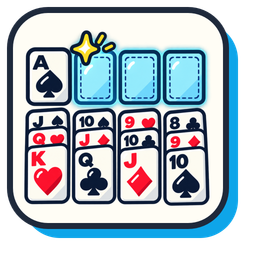
The whole deck goes out in thirteen columns of four cards, seven columns across the top row and six below. Before play begins, any King that was dealt into a column is slid to the bottom of it, so a King never sits on top of a lower card. The four foundations sit on the right.
The goal
Get the whole deck onto the foundations, building each suit up from Ace to King.
Your moves
Columns
- Only the top card of a column can move, and only on its own.
- It goes on a card exactly one rank higher, in any suit or color. A 5 of hearts can sit on any of the four 6s.
- A column that runs out of cards is out of play from then on. Nothing can be moved into it.
Foundations
- Begin each one with an Ace, then add the 2, 3 and so on in suit.
- The top card of a foundation may come back down onto a column, as long as it fits there.
Controls
- Drag a card, or click it to play it automatically: to a foundation if it can go up, otherwise to the first column that will take it.
- Hint highlights a possible move. Undo, or Ctrl+Z (Cmd+Z on a Mac), takes one back.
- Once every column runs downward one rank at a time, the game sends the remaining cards to the foundations for you.
Tips and Strategy
- Find the Aces first. Before your first move, note where each Ace is and how many cards sit on top of it. Start digging where that number is smallest, and keep an eye on the 2s and 3s that will have to follow.
- Let a column's last card go up, not sideways. A column that empties is gone for good, so moving its final card onto another column costs you a place to build. Whenever you can, wait until that last card can go straight to a foundation.
- Keep the foundations level. Racing one suit far ahead takes away cards you still need as landing spots. Once the 7 of spades goes up, it can no longer hold a 6 of any suit in the columns.
- Borrow from a foundation when you're stuck. The top foundation card can come back down as a temporary stepping stone. Sometimes that is the only move that opens a locked position, and the card can go back up a few moves later.
- Build on the Kings. Kings start at the bottom of their columns and won't leave until the rest of their suit is home. That makes a King's column a safe place for a long run going down, since nothing under the King will ever need digging out.
About Baker's Dozen
A baker's dozen is thirteen, and thirteen is exactly how many columns this game deals. The rules fit on an index card: shift a single card per move, build down by one rank in any suit, build the foundations up in suit from the Ace, and never refill an empty column. That short list hides a surprising amount of planning.
A game of skill
Since you can see all 52 cards from the outset and no new cards enter play, Baker's Dozen is a game of complete information. Your only opponent is the order the cards fell in. That makes it a great game for thinking ahead. Trace what a move uncovers, then what that card can do next, and you can often work out how to clear a whole column before you touch it.
Why the Kings start at the bottom
Picture the King of clubs dealt on top of the Ace of hearts. The King has nowhere to go: there is no higher card to put it on, empty columns are closed, and the foundation only takes it after the Queen of clubs. The Ace, and every heart after it, would be stuck behind it for most of the game. Moving the Kings underneath everything else during the deal clears away that dead end before you begin.
Not the same as Baker's Game
The names are close, but Baker's Game is a different solitaire. It works like FreeCell, with free cells for parking cards, and builds in suit. Baker's Dozen has no cells at all, and building in the columns ignores suit completely.
Medals and deal numbers
Every win on Brainzilla earns a medal based on your move count, with platinum for matching the fewest moves on record for that deal. Each day brings a Daily Challenge at three levels, and every deal has a number you can enter under Specific deal to replay it later.
Frequently Asked Questions
Can you fill an empty column in Baker's Dozen?
No. An emptied column is closed for good, and no card may be placed in it again. That's why it usually pays to let a column's last card go straight to a foundation rather than onto another column.
Does suit matter when building in Baker's Dozen?
Not in the columns. Any card can go on a card one rank higher, whatever its suit or color, so a 9 of clubs can sit on the 10 of hearts. Suit only matters on the foundations, which are built up from Ace to King in a single suit.
Why do the Kings start underneath the other cards?
Because a King can't be moved anywhere except its foundation, and only once the rest of its suit is there. Any card under a King would be stuck for a long time, so the deal tucks each King beneath the other cards in its column before play starts.
Is Baker's Dozen luck or skill?
Mostly skill. The deal is random, but every card is face up and nothing new comes into play, so everything you need to know is in front of you from move one. Whether you win depends on the order you choose for your moves.
Can I move a card back from a foundation?
Yes. The top card of any foundation can be dragged back onto a column where it fits. It's handy when you need one more landing spot to free a buried card.
Play More Solitaire
If you enjoy Baker's Dozen, chances are you like games where the whole deal is on view and the hard part is finding the right order. Plenty of solitaire games share that trait while changing how much room you get to work in.
Four open-layout games to try:
- Flower Garden also builds down regardless of suit, one card at a time, but adds a 16-card bouquet you can play from in any order, and empty columns take any card.
- FreeCell keeps the open deal but gives you four cells for parking, and runs can travel together whenever there is room to move them.
- Eight Off plays like a stricter FreeCell, building in suit, with eight cells to park cards in, four of which the deal fills for you.
- Simple Simon brings Spider's goal to a single deck: suits are built and cleared right in the columns, which start eight cards deep on the left and one card on the right.