Medium · Level 6 Perfect Fit
Levels for those who already finished the first fifteen easy ones.
How to play
- Use your mouse (or finger) to move the pieces;
- It is not possible to rotate the pieces;
- The pieces should not be overlapped.
Objective
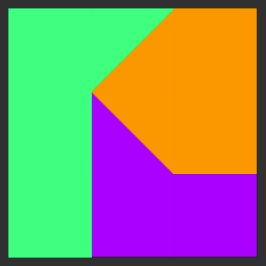
The objective is to place all the pieces inside the board without overlapping them.
The game is similar to the Tangram.
Cognitive Benefits of Playing Spatial Puzzle Games
Spatial puzzle games like "Perfect Fit" offer a variety of cognitive benefits. These games challenge your brain to think in new ways, helping to improve different mental skills. Here are some key areas that benefit:
- Spatial Reasoning: These games naturally improve your ability to visualize and manipulate 2D and 3D objects in your mind. This skill is important in fields like engineering, architecture, and design;
- Problem-Solving: You're presented with a board and a set of pieces, and your task is to make them fit together. This simple setup tests your problem-solving skills as you figure out where each piece should go;
- Attention to Detail: The no-overlap rule in "Perfect Fit" forces you to pay close attention to each piece and its orientation. Over time, this can help improve your focus and attention to detail in other areas;
- Memory: As you play more, you start to remember certain configurations and solutions. This improves both your short-term and long-term memory;
- Planning and Strategy: To successfully complete a board, you may have to plan several moves ahead. This engages your higher-level thinking and planning skills;
- Stress Reduction: Many people find that spatial puzzles have a calming effect, helping to reduce stress and improve mood. The focus required for these games can act as a form of mindfulness;
- Hand-Eye Coordination: While not as demanding as some other games, moving pieces with your mouse still helps improve your hand-eye coordination;
- Multi-Tasking: As you advance to more complicated boards, you'll often find yourself keeping track of multiple pieces and potential placements simultaneously;
- Flexibility: The inability to rotate pieces in "Perfect Fit" can initially seem like a limitation, but it actually forces you to be more flexible in your thinking, as you must adapt to the shapes as they are.