Eight Off Solitaire
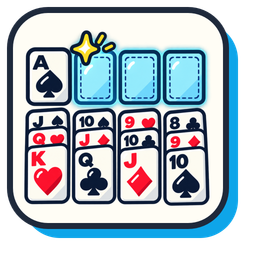
In Eight Off, the deal starts the work for you. All 52 cards come out face up, 48 of them in eight columns of six, and the last four are already sitting in four of the eight cells above the columns. From there it's a game of tidy, strict building: down in suit only, with empty columns reserved for Kings. Since nothing is hidden, each deal is a puzzle you can read in full before you touch a card.
How to Play Eight Off Solitaire
At a glance
- Cards: one 52-card deck, every card face up
- Tableau: eight columns of six
- Cells: eight, four of them filled by the deal
- Building: down in suit; empty columns take Kings only
The setup
Forty-eight cards are dealt face up into eight columns of six. The last four cards go into four of the eight cells along the top, so you begin with four cells occupied and four free. The foundations run down the right-hand side.
The goal
Bring all four suits home to the foundations, each one climbing from its Ace to its King.
Your moves
Columns
- A card goes on the next-higher card of the same suit, such as the 4 of diamonds on the 5 of diamonds.
- A same-suit run can move as a unit if it is no longer than the number of free cells plus one. With three cells free, you can move up to four cards. Empty columns don't raise that limit.
- An empty column accepts a King and nothing else, though the King may bring a same-suit run along with it.
Cells
- Each cell holds a single card.
- Any top card from a column can go into a free cell, and a card in a cell can come out again onto a column or a foundation.
Foundations
- Start each one with an Ace and add cards upward in suit.
- Cards that reach a foundation stay there.
Controls
- Drag cards, or click a top card or the first card of a same-suit run to move it automatically: to a foundation first, then to a column, and as a last resort into a free cell.
- Hint suggests a move, and Undo or Ctrl+Z (Cmd+Z on a Mac) takes one back.
- Once every column is in same-suit order, the game finishes the job for you.
Tips and Strategy
- Look for suit knots. If the 5 of clubs lies above the 4 of clubs in the same column, the 4 can't use it as a home until the 5 has moved to the 6 of clubs or a cell. Spot these knots early, since untying one often costs you a cell.
- Think of free cells as moving power. Each empty cell lets you move one more card in a single run. With all eight cells free, a run of nine can travel at once; with every cell taken, you are down to single cards. Fill a cell only when the move is worth that loss.
- Plan your empty columns around Kings. A gap only takes a King or a run that starts with one. Clearing a column pays off most when a King is sitting on cards you need.
- Empty the starting cells early. The four cards the deal parks in the cells are costing you capacity from move one. Look for quick ways to place them on columns or foundations.
- Play to the foundations without worry. In a same-suit game, the only card that could ever sit on the 8 of hearts is the 7 of hearts, and it has to be on the foundation before the 8 can go up. So sending a card home never takes away a spot you still need.
About Eight Off Solitaire
Eight Off belongs to the FreeCell family: one deck, every card face up, and a row of cells where single cards can wait. The differences are in the details, and they add up to a game with its own rhythm. Building in suit makes the columns tidy but strict, and the half-filled cells mean you start every deal by winning back space.
Eight cells, half full
Eight cells sounds like a lot, and it is, but only four are open when you start. The other four have to be earned by finding homes for the cards the deal parked there. Those cells also set the size of your group moves: the number of free cells plus one, so every card sitting in a cell makes your longest possible move one card shorter.
One home per card
With same-suit building, every card has exactly one possible spot in the columns: the next-higher card of its suit. That makes Eight Off easier to read than alternating-color games, where a card often has two choices. It also means there is no backup plan. If that one landing card is buried, the card you want to move has to wait, or take a cell.
On Brainzilla
Eight Off has a Daily Challenge every day in Easy, Medium and Hard, and each win earns a medal based on how few moves you needed. Hint and Undo are both on hand. Every deal also has a number, so you can return to a tricky one under Specific deal.
Frequently Asked Questions
What is the largest run I can move in Eight Off?
One more than the number of free cells. With three empty cells you can move a same-suit run of up to four cards, and with no empty cells you can only move one card. Empty columns don't add to the limit.
Which cards are allowed in an empty Eight Off column?
A King, alone or leading a same-suit run, and nothing else. Any other card has to go on a column or into a cell.
How is Eight Off different from FreeCell?
Start with the columns: Eight Off builds them in suit and saves empty ones for Kings, where FreeCell builds in alternating colors and lets anything into a gap. Then the cells: Eight Off has eight rather than four, but the deal fills four of them, so you begin with the same number of free cells either way.
Why are some cells already full when the game starts?
The deal puts six cards in each of the eight columns, which uses 48 cards. The remaining four go into the cells, leaving the other four empty for you.
Can I move a card back from a foundation?
No. In Eight Off, cards stay on the foundations once they get there. Because building is in suit, that never costs you a landing spot you would still need.
Play More Solitaire
Eight Off is one of several games built around cells and fully open deals. The games below change the number of cells, the building rule, or whether there are cells at all.
Close relatives:
- FreeCell starts with every cell empty and is far looser about empty columns, which take any card, but asks you to alternate colors.
- Penguin begins its foundations at whatever rank the deal sets and lets runs wrap from Ace round to King, with seven cells and the same in-suit building.
- Flower Garden builds without caring about suit, and in place of cells it fans out 16 cards that are all playable from the start.
- Baker's Dozen closes every column for good once it empties and moves one card at a time across thirteen open columns, with nowhere at all to park a card.